How to test Meta ad creatives without burning your budget
Creative testing on Meta doesn't have to be expensive. Here's a simple framework for small business owners to find what works — without wasting ad spend.

Most small business owners test Meta ad creatives the wrong way.
They run one ad, wait two weeks, decide it "didn't work," and either give up or try something completely different. No data. No conclusions. Just money spent and a vague feeling that Meta ads are a waste.
The problem isn't Meta. It's the testing method.
Done right, creative testing tells you exactly what your audience responds to — and every test makes the next campaign better. The key is structure. Here's how to do it without spending more than you're comfortable losing.
Why creative testing matters more than most things in Meta ads
In Meta advertising, your creative is the single biggest performance lever you control.
Targeting has become less precise since iOS 14. Audiences overlap more than they used to. Bidding is largely automated. What you can still control — and what the algorithm rewards — is creative quality.
Meta's delivery system learns which creatives generate results and shows them more. But it can only optimise across what you give it. One creative gives the algorithm nothing to work with. Three to five creatives across different approaches give it real signal to optimise toward.
More practically: you simply don't know what will work until you test. A creative you thought was weak often outperforms the one you spent the most time on. The only way to find out is to run them.
The right mindset before you spend a cent
Testing is not "running ads and seeing what happens." It's a structured experiment with a hypothesis.
Before you launch anything, answer these two questions:
1. What am I testing?
Pick one variable per test. Headline vs. headline. Product photo vs. lifestyle photo. Text-led creative vs. image-led creative. If you change multiple things at once, you can't attribute the result to anything specific.
2. What result tells me this worked?
Set a threshold before you start. For most small businesses this is cost per click, cost per purchase, or return on ad spend. Decide in advance what number means "this creative wins." Otherwise you'll keep moving the goalposts.
How much to spend on a creative test
A common fear: "What if I spend €500 testing and learn nothing?"
The answer is to spend less per test, not to avoid testing.
A practical budget for small business creative testing:
Minimum per creative per test: €5–10/day
Minimum test duration: 3–5 days (less than this and Meta's delivery hasn't stabilised)
Minimum budget for a 3-creative test: €150–250 total
That's enough to get meaningful data on which creative direction performs better — not enough to declare a definitive winner, but enough to kill the obvious losers and double down on the promising ones.
If that feels like too much, start with €5/day per creative and run for 5 days. €75 total. Enough to see early signal.
The 3-creative test: the simplest framework that works
For most small businesses, the best starting point is a three-creative test targeting the same audience, same budget, same copy — with only the creative changing.
Creative A: Product-led
Your product is the hero. Clean image, product front and centre, minimal text. This is the "show me what it is" version.
Creative B: Outcome-led
Focus on the result, not the product. If you sell an ad creative tool, the outcome is "professional Meta ads in 5 minutes." Show that result — a finished creative, a satisfied founder, a before/after.
Creative C: Text-led
A bold statement or question dominates the frame. Minimal imagery. This works surprisingly well for service businesses and anything where the value proposition is the hook, not a visual.
Same audience. Same budget split equally across all three. Let them run for 5 days minimum.
At the end: kill the lowest performer, keep the top two, and create a variation of the winner to test next.
How to structure your campaign for clean results
Messy campaign structure ruins test data. Here's the setup that keeps results clean:
One campaign → one ad set → multiple ads
Put all three test creatives inside a single ad set with the same audience, budget, and placement settings. This ensures Meta is making delivery decisions only based on creative performance — not audience differences or budget allocation.
Turn off Meta's "Advantage+ Creative" for test campaigns
This setting lets Meta automatically modify your creatives — adjusting colours, adding music, changing aspect ratios. Useful in production campaigns, a problem in tests. You want to know how your creative performs, not Meta's modified version of it. Turn it off.
Use manual placements during testing
Auto placements serve your ad everywhere and blends performance data across contexts. During a test, pick one placement (feed only, or stories only) so you're comparing like for like.
What to look at — and what to ignore
After 3–5 days, you'll have data. Here's what actually tells you something:
Look at:
Click-through rate (CTR) — which creative gets people to stop and click
Cost per click (CPC) — which creative gets clicks most efficiently
Cost per result — if you have enough conversions, which creative drives them at the lowest cost
Ignore (in short tests):
Relevance scores and quality rankings — these need volume to be meaningful
Reach and impressions — a creative with high reach but low CTR isn't performing
Frequency — only matters in longer-running campaigns
The most important metric depends on your goal. If you're driving traffic, CTR and CPC matter most. If you're driving purchases, cost per purchase is the only number that matters — but you need at least 20–30 purchase events per creative to draw conclusions.
The iteration loop: how to get better over time
One test is useful. Consistent testing compounds.
The loop looks like this:
Run a 3-creative test
Kill the loser, keep the top two
Create a new variation that takes the best element of the winner and pushes it further
Test the original winner against the new variation
Repeat every 4–6 weeks
Over time you build a clear picture of what your specific audience responds to. Which visual style. Which type of headline. Which proof point. That knowledge is an asset no competitor can copy — it lives in your campaign data.
How creative volume affects your ability to test
The biggest bottleneck for most small businesses isn't budget — it's creative production.
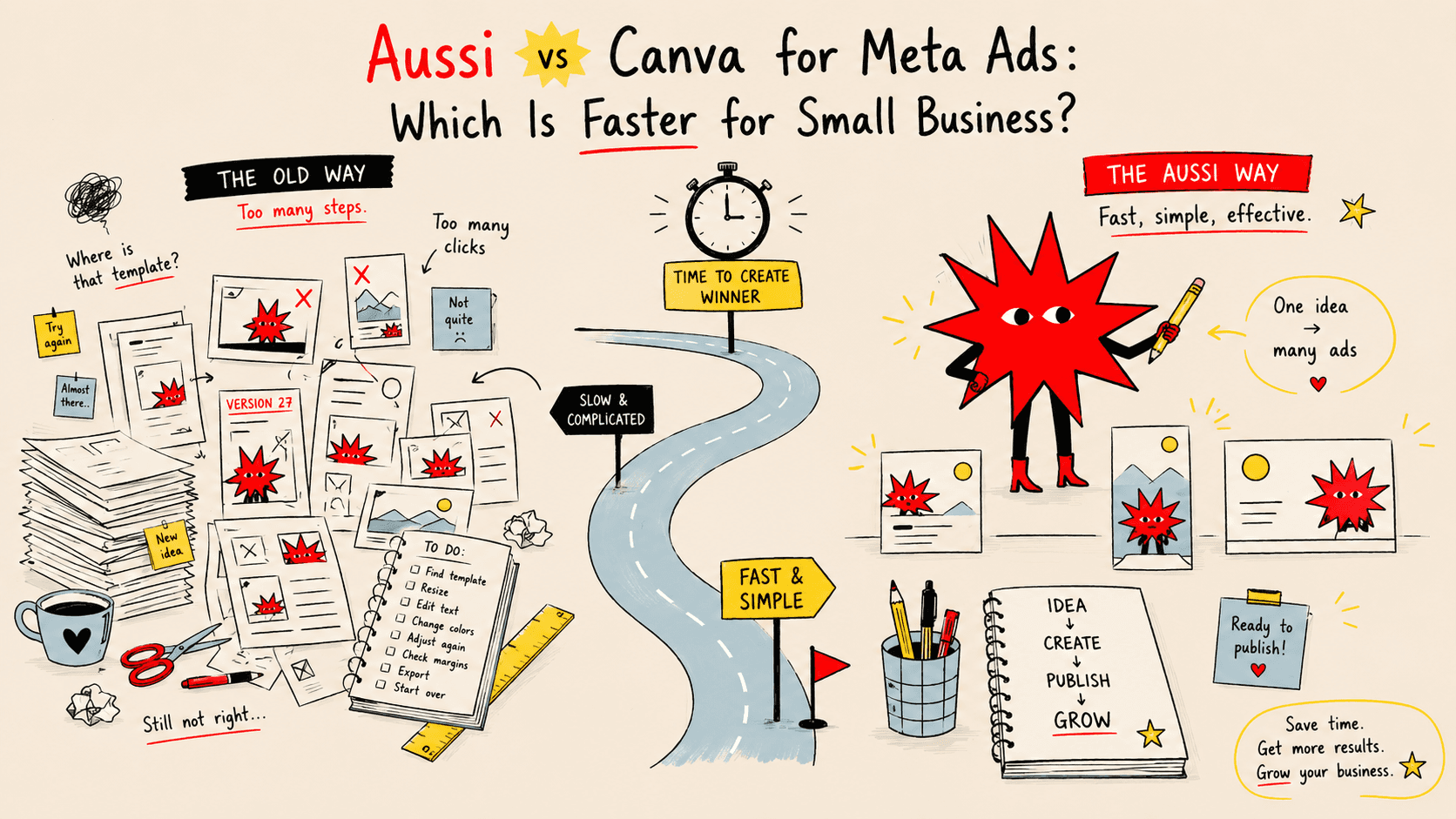
Testing requires new creatives regularly. If producing one creative takes you two hours in Canva, you'll test once and stop. If it takes 5 minutes, you'll test constantly.
This is where Aussi AI changes the math. You can generate three or four creative variations in the time it used to take to make one — which means the testing loop above becomes something you actually maintain, not just something you plan to do.
More creative volume → more tests → faster learning → better results. That's the compounding advantage.
Common testing mistakes
Testing too many variables at once. If creative A has a different image, different headline, and different colour scheme than creative B, you can't learn anything from the result. Change one thing.
Stopping too early. Three days of data is not enough unless one creative is dramatically outperforming the others. Give tests at least 5 days before drawing conclusions.
Testing with too small a budget. €2/day per creative won't generate enough impressions for the data to mean anything. €5–10/day is the practical minimum.
Scaling a winner before testing it properly. A creative that wins at €10/day doesn't always win at €100/day. Test at scale separately before committing budget.
Never refreshing creatives. Creative fatigue is real. Even a strong performer will decay after 4–6 weeks. Schedule new creative tests before you see performance drop — not after.
Quick-start checklist
Before launching your first creative test:
Three creatives ready — each testing a different visual approach
Same audience, same budget, same placement across all three
Advantage+ Creative turned off
Manual placements selected
Test duration set to minimum 5 days
Success metric defined before launch (CTR threshold, target CPC, or target cost per result)
Calendar reminder to review results on day 5
The fastest way to test more is to produce more.
Aussi AI generates multiple Meta ad creative variations from your product URL in minutes — feed, stories, and reels included. The more you test, the better your ads get. Try it free →